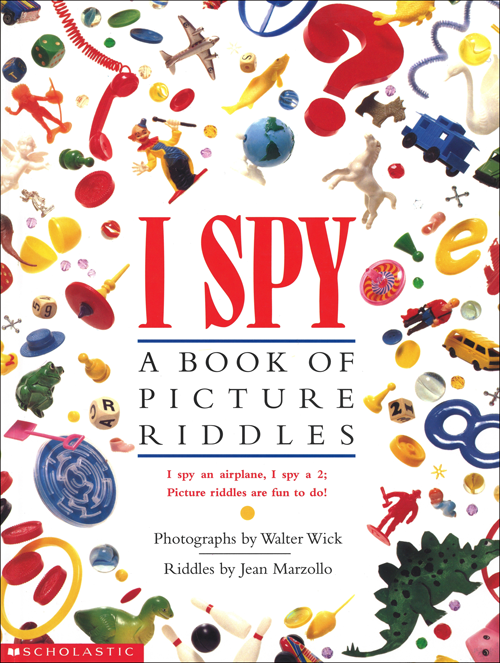
I wrote this book not knowing what a success I SPY would be. No one knew. Here's how it happened. In the 1970's and 80's, I was editor of a kindergarten magazine called Let's Find Out at Scholastic. I worked with the wonderfully talented art director, Carol Devine Carson. In 1986 a photographer named Walter Wick sent Carol a promotional picture of hardware store type objects floating in space. Carol suggested that his work could give our magazine a new look. I agreed. Walter's photo was perfect for kindergarten because it was fun to look at, beautiful, and clear. We met with Walter and gave him a job. "We'd like you to make a huge poster of buttons, barrettes, paper clips, rubber bands, and so on. It will be called Fasteners," said Carol. "These are objects that 5-year-olds understand," I added. Walter made a fabulous poster that teachers, kids, and people at Scholastic hung on their walls to enjoy. We hired Walter to make more pictures of blocks, toys, leaves, and rocks. Little did we know that they were precursors to I SPY.
Then one day Bernette Ford, editorial director of Cartwheel books at Scholastic and editor Grace Maccarone, who had published other books of mine, suggested that I ask Walter and Carol if they would like to work with me on a book. I asked them and guess what? They both said yes, and that was the beginning of I SPY. Bernette and Grace nurtured all eight of the original I SPY books carefully and well, and I am very grateful to them.
To get the first book started, we met in Bernette's office and discussed what the book would be like. I remember that, at one point, editor Grace mentioned the kids' game "I Spy With My Little Eye." I wrote that down and eventually used the words "I spy" to start every riddle. Those two little words are very powerful because they establish the main character and the story of the book. The main character is the reader - or the child being read to. The story is about the main character becoming a hero by finding everything in the riddle - and even a superhero by finding everything in the extra credit riddle as well.
 At the time we started work on I SPY, I had published 30 children's books, illustrated by various artists, such as Susan Jeffers, Steven Kellogg, and Jerry Pinkney. In all thirty of those books, I had written the text first, sold it to a publisher, who then asked an illustrator to create the pictures. I SPY was going to be different. Right from the start Walter, Carol and I worked together as we had on the magazine.
I am grateful that Carol was a wonderful designer. She advised Walter when he needed it, designed an elegantly simple page that showed Walter's photos as big as they could be with a clean, clear text underneath, and delivered all the mechanicals (final layouts) to Scholastic.
I am grateful that Walter was not only an excellent photographer but also an experienced creator of photographic games and puzzles.
And I am grateful that I was in a kindergarten frame of mind when I wrote I SPY. It never occurred to me to write the riddles for older children. Had I done that, younger kids would not be able to be I SPY heroes. I couldn't write the riddles before Walter made the photos. That would have inhibited his creativity. We worked together, discussing ideas, words, rhymes, and rough drafts (Polaroids). I kept notes and, after the final photo was done, I wrote the final riddle.
Kindergartners need concrete, understandable objects to think about. The
I SPY books do not depend on kids understanding abstractions, such as a country called Canada. If I call for CANADA, I call for a word spelled in uppercase letters that match the uppercase letters in the riddle. Nor does I SPY depend on kids having a knowledge base. I do not call for "the 16th president of the United States." I call for a "penny" or a "coin" or a "face."
To play I SPY you need a reasonable vocabulary and visual discrimination skills.
I wrote the riddles in rhythm and rhyme because kids like it, I like it, and it fits the spirit of the hunt. Kids in Miami taught me that you can rap I SPY. They are right! Try it! Because I hoped that kids would make up new riddles for the I SPY books, I asked Walter to put lots of rhyming objects in the pictures. He was happy to oblige.
I SPY: A BOOK Of PICTURE RIDDLES was set to be published in 1992, but folks at Scholastic became so excited about advance copies that they rushed it into bookstores in Fall 1991. People love it!
I was very pleasantly surprised to learn that because I SPY works for kindergartners, it also works for ages 5 and up. Walter's photographs are beautiful, clear, and sophisticated so older kids, teenagers, parents and grandparents all enjoy being I SPY heroes, too. As the years have gone by, I've learned that many English language learners and special education learners enjoy I SPY, as well. It seems that most everyone likes a jelly bean hunt, and I SPY is a grand one.
“Excellent, sharp photographic work combined with ingenuity and imagination make this well-conceived book a winner.”
PUBLISHERS WEEKLY
“One of the more successful efforts in the ever-growing crop of visual game books … An appealing book for children and adults to share and enjoy together.”
SCHOOL LIBRARY JOURNAL
“Clever couplets serve as clues that lead the reader on a merry visual chase through more than a dozen full-color photo montages … Beware: The artfully designed riddles are harder than they first appear.”
SEATTLE TIMES