POTATO RACES
Age Level: 7 and up
Number of Players: 2 or more
What Is Needed: 1 potato and 1 spoon for each player
Type of Game: competitive
Location: outside or inside
RACE 1: POTATO JUMP RACE
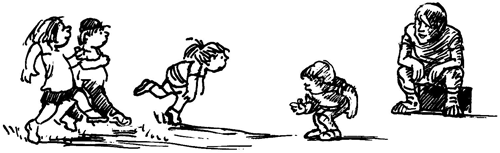
Establish a start and finish line. Line the children up on the start line. Give the children potatoes to put between their thighs. Say, "Ready, on your mark, get set, go," and see who can jump to the finish line first without dropping the potato.
RACE 2: POTATO SPOON RACE
Establish a start and finish line. Line the children up on the start line. Give the children potatoes and spoons and show them how to hold the spoon in their mouths and carry the potato on it. Say, "Ready, on your mark, get set, go," and see who can get to the finish line first without dropping the potato or the spoon.
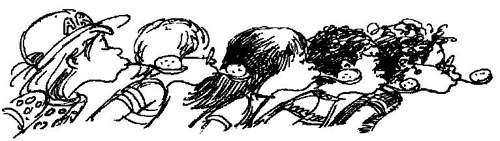
These games may require different-sized potatoes: large ones for the Potato Jump Race and smaller ones for the Potato Spoon Race. Tennis balls and Ping-Pong balls can also be used. These two races combine well with the game Hot Potato.
SIMON SAYS
Age Level: 3 and up
Number of Players: 2 or more
What Is Needed: nothing
Type of Game: competitive or noncompetitive
Location: inside or outside
HOW TO PLAY
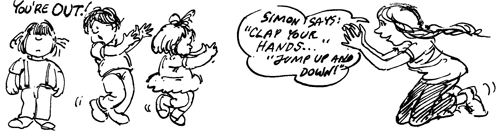
An adult or child is Simon at first. Simon faces the rest of the players, who stand where they can see Simon well. Simon gives commands for the children to follow, such as "Simon says, 'Clap your hands,''' or "Simon says, 'Kick your feet.''' The children are to obey only those commands that begin with the words "Simon says." If the command does not begin with these words (for example, "Stamp your feet"), the players should ignore it.
COMPETITIVE VERSION
Any player who obeys a command not preceded by "Simon says" is out. Speed up the game as the children get good at it. The last player left wins.
NONCOMPETITIVE VERSION
Enjoy a good laugh with the child who obeys a wrong command, but do not send this child out of the game. Keep on playing until interest wanes.
SNATCH THE FLAG
Age Level: 5 and up
Number of Players: 5 or more
What is Needed: a handkerchief or a piece of cloth for each player
Type of Game: competitive
Location: outside
HOW TO PLAY
Everybody puts a handkerchief in a back pocket or back waistband. Part of the handkerchief should be hanging out. The object is for each person to get other players' "flags" without losing his or her own. The rules: no tackling and tripping; anyone who loses a flag must go sit on the sidelines. The winner is the last person to have a flag.
KICK THE CAN
Age Level: 7 and up
Number of Players: 4 or more
What Is Needed: a tin can
Type of Game: noncompetitive
Location: outside
HOW TO PLAY
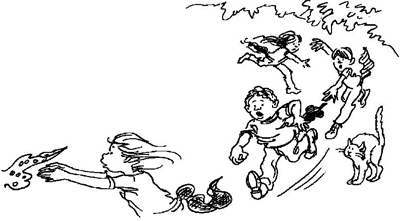
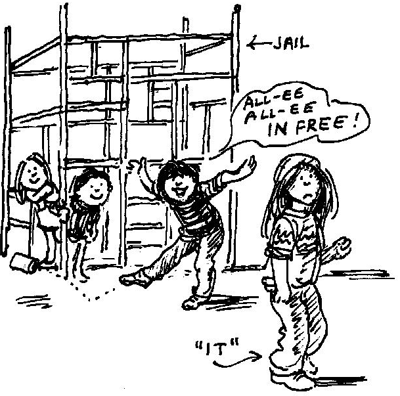
Establish a small area called "Jail" (often it is the middle of the lawn). Place a tin can in the Jail. "It" gets a running start and kicks the can as far as he or she can. As soon as the can is kicked, the other players run and hide. It retrieves the can, brings it back to Jail, and counts to 50 or 100. Then It sets out to find the hidden players. When It spots one, It runs back to the can and yells, "I see Ned behind the tree!" Ned must surrender and come to Jail. When the last player is captured, another round is begun with the first player captured as the new It.
At any point while It is out hunting, a player can run to Jail and free all the prisoners there with the cry, "All-ee-all-ee-in-free!" The rescuer then kicks the can as far as he or she can, and It must come back, retrieve it, and start counting all over again. This game can go on a long time!
RED ROVER
Age Level: 6 and up
Number of Players: 6 or more
What Is Needed: nothing
Type of Game: competitive (sort of)
Location: outside
HOW TO PLAY
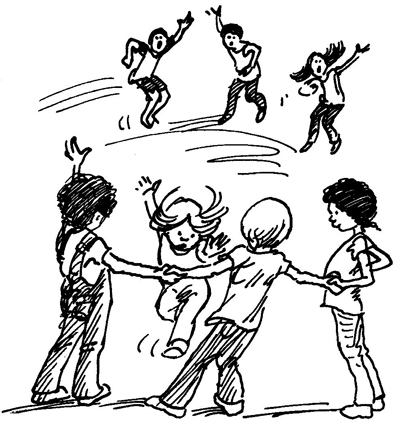
Divide the players into two teams. The teams link arms and stand opposite each other about fifty feet apart. "It" should be at the end of one line so he or she can go first, naming a child (let's say Janie) on the other team this way: "Red Rover, Red Rover, let Janie come over." Janie then runs across the play area and tries to break through the chain of opposite players. If she breaks through, she goes back to her own team. If she doesn't, she joins the team she couldn't break through. Theoretically, the last person to join a chain is the winner, but often the game doesn't get this far. Play just until the children feel like playing something else.
RUN, RABBITS, RUN!
Age Level: 5 and up
Number of Players: 5 or more
What Is Needed: nothing
Type of Game: competitive or noncompetitive
Location: outside
HOW TO PLAY
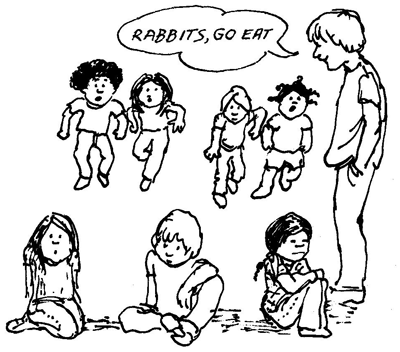
One child picks one or two other children to be "foxes." They go and sit in a "foxhole" at the far end of the playing area, with their backs toward everyone. The rest of the children are "rabbits." They line up at the other end of the playing area, facing the backs of the foxes. When a grownup says, "Rabbits, go eat," the rabbits creep across the playing area toward the foxes. When the grownup yells, "Run, rabbits, run!" the foxes jump up and chase the rabbits back to their starting line. Any rabbits who are caught by foxes become foxes.
COMPETITIVE VERSION
Play until there is only one rabbit left-the winner.
NONCOMPETITIVE VERSION
The last rabbit left takes the grownup's place, giving the commands "Rabbits, go eat" and "Run, rabbits, run!" Play until the children tire of the game.
SPUD
Age Level: 7 and up
Number of Players: 3 or more
What is Needed: a dodge ball, beach ball, or other ball that size
Type of Game: noncompetitive
Location: outside
HOW TO PLAY
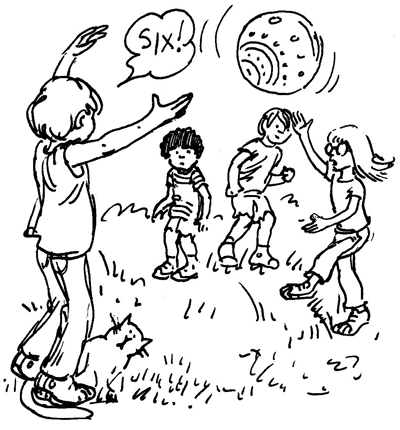
The players number off and remember their numbers. "It" throws the ball up into the air, calling a number at the same time. The player whose number has been called tries to catch the ball. If he or she doesn't catch it, It throws again and calls out a difference number. If the player does catch the ball, he or she can take up to three big steps and throw the ball at any other player. If someone is hit, that player gets an S. It can take up to three more steps and throw the ball at another player. The players dance around It, trying to avoid being hit but tempting It to try for them. It continues to try to hit them, and as they are hit, they get the letters S, P, U, and D. The first to spell SPUD becomes the next It.
BLIND MAN'S BLUFF
Age level: 5 and up
Number of Players: 3 or more
What is Needed: a blindfold
Type of Game: noncompetitive
Location: inside or outside
HOW TO PLAY
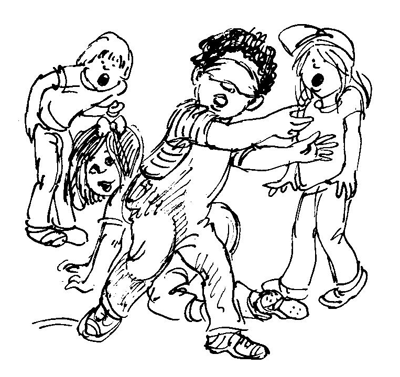
Blindfold "It". Spin It around several times, then stop. The other players move around It, making funny sounds as It tries to tag them. The first person tagged becomes It.
VARIATIONS
Change the name of the game and specify the sounds to be made. For example, to play Astronaut's Buff, tell the players to make only spaceship sounds.
DUCK, DUCK, GOOSE
Age Level: 4 and up
Number of Players: 5 or more
What is Needed: nothing
Type of Game: noncompetitive
Location: inside or outside
HOW TO PLAY
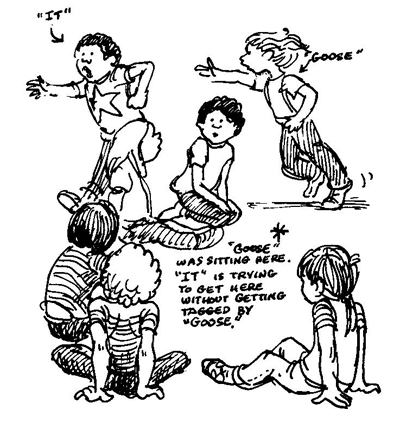
The children sit in a circle. "It" walks around the outside of the circle tapping each child on the head lightly, saying "Duck" with each tap until It finally taps a player and says "Goose!" The Goose then jumps up and chases It around the outside of the circle, trying to tag him or her before It reaches the empty space. If It gets there first, the Goose becomes the next It. If Goose catches It, the same child is It again.
VARIATIONS
This is a very good game for children four to six. To adapt this for a party, change the name to suit the party's theme: Bat, Bat, Dracula for a Halloween Party or Miss, Miss, Hit for a Space Party or Baseball Party, and so on.
Click here for more Party Games!
All of these games, and lots more, can also be found in my book,
"Birthday Parties: How to Give Them, How to Survive Them".
Click here to see the entire book, online for FREE!
Based on the book Birthday Parties for Children: How to Give Them, How to Survive Them.
Text © Jean Marzollo 1983-2016, Illustrations © Irene Trivas 1983-2016
|